Facing a Future Shaped by COVID-19: How Public Universities Are Handling the Crisis
Feature Story
By Sara Frueh
Last update June 2, 2020
Many U.S. colleges and universities responded to the COVID-19 pandemic this spring by swiftly moving courses online, but they now face a range of longer-term quandaries, from weighing how to safely reopen campuses to navigating new financial challenges.
In a virtual town hall discussion, three public university presidents — Ana Mari Cauce of the University of Washington, Michael Crow of Arizona State University, and Mitchell Daniels Jr. of Purdue University — discussed the upheaval caused by the pandemic, their plans for the fall, and unexpected silver linings.
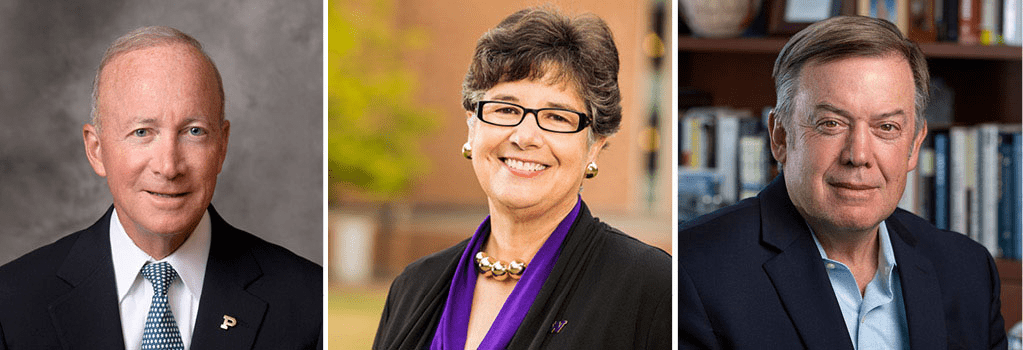
“We know that our institutions must not just adapt, but they have to lead with new models,” said National Academy of Sciences President Marcia McNutt in opening the discussion, which was co-hosted by the National Academies and Issues in Science and Technology.
Embracing hybrid approaches for fall
All three university presidents said that in-person classes would be part of their schools’ fall experience, along with technologies to enable offsite learning.
The University of Washington is actively planning to bring students back to campus in the fall, said Cauce. “We know that a very important part of the learning experience happens in the classroom, from other students, but also outside of the classroom — in their interactions with faculty, in labs, with each other.” But it will be a new normal that uses a hybrid approach, she said; while they hope to hold small classes in person, large lecture classes will move at least partly online.
This summer Arizona State University will spend $10 million to $15 million implementing Zoom technology in all 800 of its teaching spaces, so that in the fall, students and faculty members who aren’t able to attend in person can join virtually, said Crow.
Daniels described the range of steps Purdue University is taking to lower health risks for students and employees returning to campus, including reducing the density of student populations in residence halls, cutting classroom occupancy by at least 50%, and having instructors teach from behind Plexiglas shields. But he emphasized that outcomes will depend on more than physical and policy changes.
“The decisive factor — the single most important factor — will be behavior on the campus,” said Daniels. “We’re working just as hard on that.” For example, students will be required to sign a code of behavior promising to wear masks indoors, maintain social distance, and report any symptoms of illness.
Weathering financial challenges
Public universities also anticipate falling budgets, as the economic crisis caused by the pandemic has lowered revenues in state coffers.
“On the public side, there will be big, big cuts,” said Daniels, expressing concern that while Purdue will survive because of financial reserves banked over many years, some smaller schools may not.
Crow stressed the need for schools that are on shaky ground to combine their resources with other institutions — for example, by sharing faculty in certain fields. “We need to find a way for a lot of colleges and universities to stop thinking they can live in isolation with one another,” he said. “We’ve got to find a way to team up, to league up.”
Cauce cautioned that public universities need to stop staking their reputations on how many students they don’t accept, and instead focus on serving the community — and working with students to support their success, rather than just accepting students for whom success is almost a given. “If we are going to ask for more public investment, we have to put our public mission front and center.”
Lessons learned from the crisis
Has the pandemic produced any lessons that can be used to improve how institutions operate going forward?
“All crises produce new ways of thinking,” said Crow. Public universities have been operating under a system that relied nearly entirely on face-to-face learning, but wider use of technology is now furthering education’s reach, he said. “A new socio-technical capability can now spread our ability to project our learning environment and our teaching environment and our discovery environment.”
Paradoxically, the pandemic has also illuminated the importance of in-person education, Daniels pointed out. “It’s clear to us that students and their families have had underscored for them the invaluable character of on-campus, in-person interaction with faculty and with each other,” he said. “Clearly if there was ever a doubt that that adds a lot of value, it’s been dispelled.”
The pandemic has also inspired universities to serve their communities in new ways — by undertaking COVID-19 testing efforts, for example, and by leveraging basic research and models in the fight against the virus, said Cauce. “We have really shown how, in this moment of crisis, universities have been leading.”
Advice to incoming and future students
Asked what advice he would give to incoming freshmen, Crow urged them to “think like a surfer — that is, agile, flexible, adaptable. You will go in the water, and you need to find your way out.”
Cauce pointed to Franklin Delano Roosevelt’s observation that ‘To some generations, much is given. From other generations, much is expected.’ She noted, “This is a generation from whom much will be expected…. Higher education will give you the tools that will allow you to deal with these challenges more effectively.”
What about advice for high school juniors and seniors considering college? “Be ready to drive a hard bargain,” said Daniels, urging them to demand high value from the schools competing for their attention.
Watch the recording of the town hall discussion.
More like this

Discover
Events
Right Now & Next Up
Stay in the loop with can’t-miss sessions, live events, and activities happening over the next two days.
NAS Building Guided Tours Available!
Participate in a one-hour guided tour of the historic National Academy of Sciences building, highlighting its distinctive architecture, renowned artwork, and the intersection of art, science, and culture.